You're not in the room. Your document is.
Somewhere right now, a decision is being made about you. A promotion round. A budget meeting. A shortlist getting shorter. You are not there. Something of yours might be: the update you sent Tuesday, the proposal you finished at midnight, the one-pager your manager forwarded up the chain.
As far as that room is concerned, the document is you. It speaks when you can't. And most documents are terrible at the job.
The unfair part
Two people do comparable work for a quarter. One of them writes it up well. Ask anyone who has watched a calibration meeting from the inside: the write-up wins. The credit follows the artifact, because the artifact is the only part of the work anyone else ever sees. A quarter of real effort compresses into six paragraphs, and the reader never saw the effort. They saw the six paragraphs.
This is unfair. It is also usable, and the people who level up fastest tend to be the ones who noticed early.
Ten seconds
The game got harder recently, from both directions.
Attention collapsed first. The person deciding your budget reads your update on a phone, between two meetings that both ran long. You get about ten seconds before they decide whether it deserves a real read. Ten seconds is plenty for a chart. It is nothing for paragraph three, which is where your best number is currently hiding.
Then writing got cheap. Everyone has an assistant now, so everyone writes more, and the inboxes above you are flooding with competent prose. Being well written is a commodity. Being read is the scarce thing, and it is getting scarcer.
The skill nobody names
Look closely at how senior people's documents differ from everyone else's. The numbers are set large. The ask is impossible to miss. The structure is visible from across the room, so a skimmer still leaves with the point. Some of that is craft. A lot of it, historically, was help: a chief of staff who restructured the memo, or simply the time to fuss over it.
Presentation gets dismissed as vanity, and that is the misread of the decade. Presentation is logistics. It determines whether your thinking arrives. A brilliant recommendation in paragraph nine did not happen, professionally speaking, and no one will ever tell you that is why.
What the difference looks like
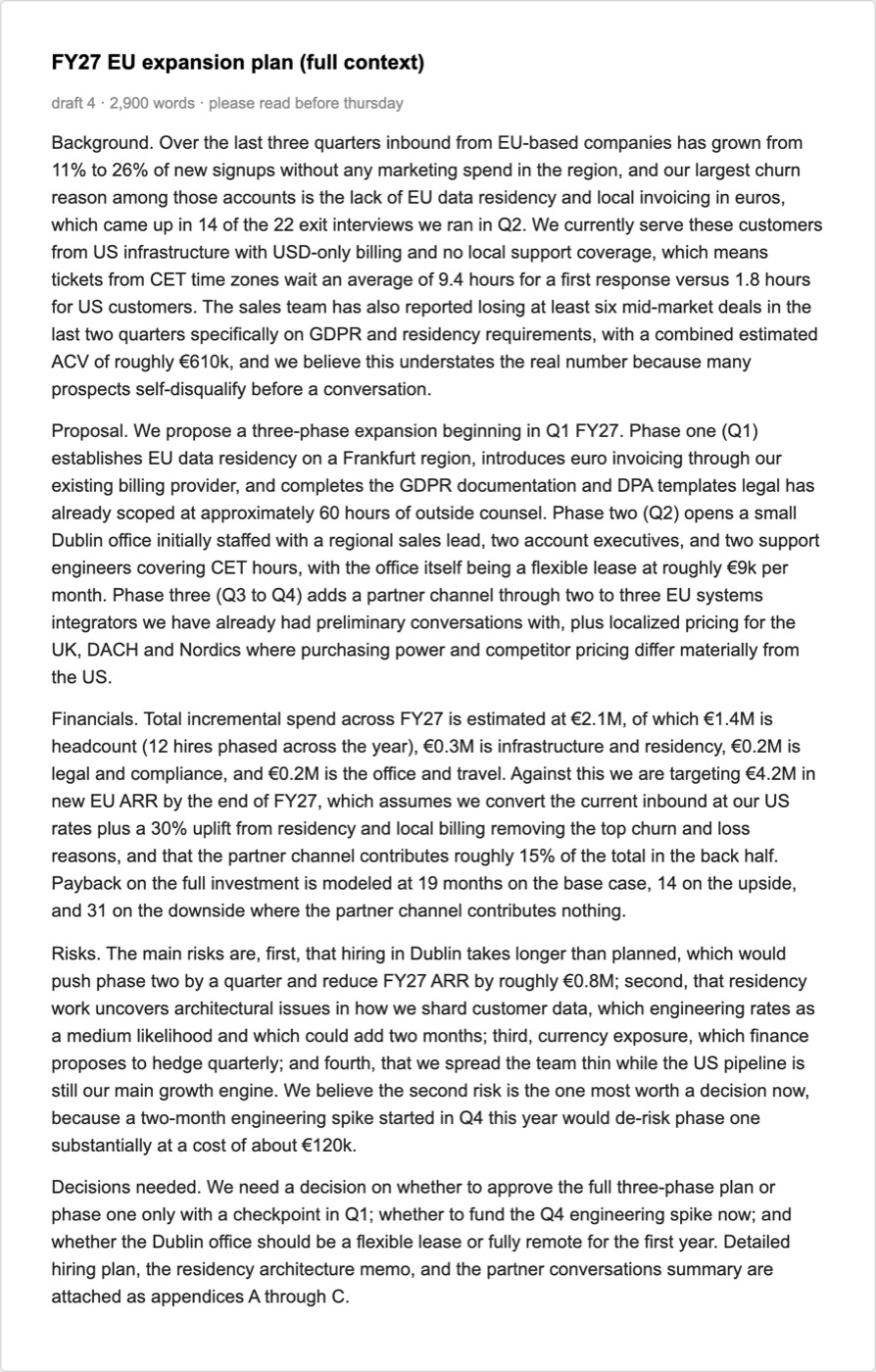
Here is the same technical plan twice. First, what got sent: 2,900 words, the ask in the last paragraph, fourteen minutes of reading nobody was going to do. Below it, what an executive actually got through: the spend and the target up top, the three decisions in cards, two minutes.
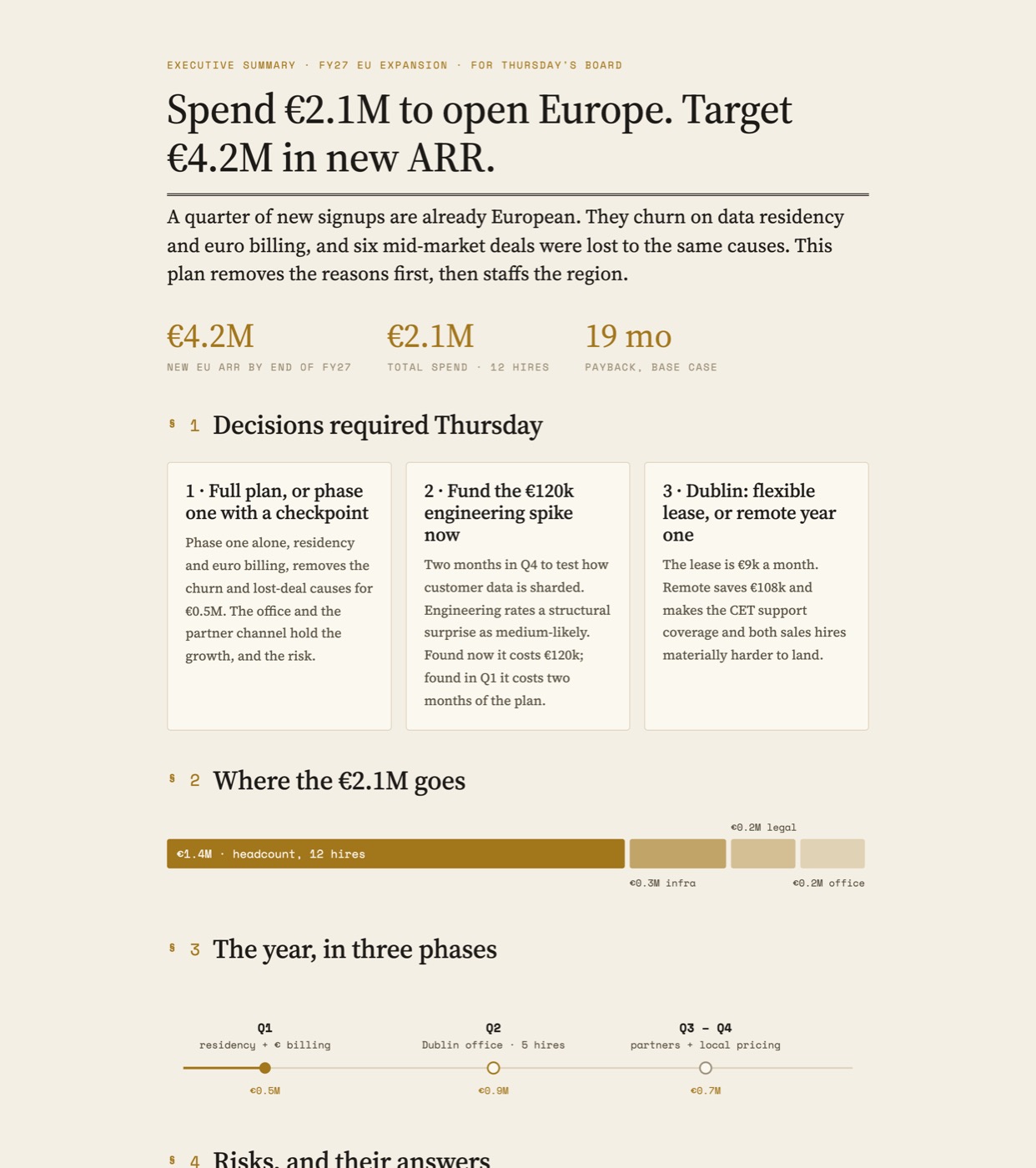
It works on drier material too. An RFC in full SHALL-and-MUST voice becomes a page with the one-line version at the top and the deadline drawn on a timeline. That one is live as well. The thinking in both cases was already done. What changed is whether it arrived.
What actually works
None of this requires talent. It requires doing four things most people skip.
- Put the ask where a skimmer stops. Top of the page, called out. If they read one line, they should leave knowing what you need.
- Set one number big. One number displayed like it matters beats five buried in prose. Pick your best one and give it the room.
- Label the decisions. Decided, tentative, needs an owner. Readers act on what they can see the status of.
- Assume the phone. If it only works on a laptop with full attention, it only works in a meeting you would not have needed the document for.
Do this manually and it costs you an afternoon per document. That afternoon is why most people never do it, and why the ones who do stand out so much.
The afternoon, removed
This is why we built foldout. The packaging half of professional writing was always the gated half: it took design skill or design help, and it took time nobody had. Now it takes a paste. What you wrote comes back as a page people finish, with the numbers set to be seen and the asks called out, and the same source becomes the deck and the PDF when someone upstairs asks for one.
The thinking stays yours. The logistics stop costing you Sunday.
The room will decide something about you this quarter either way. Your document gets a vote. Send one that gets read to the end.